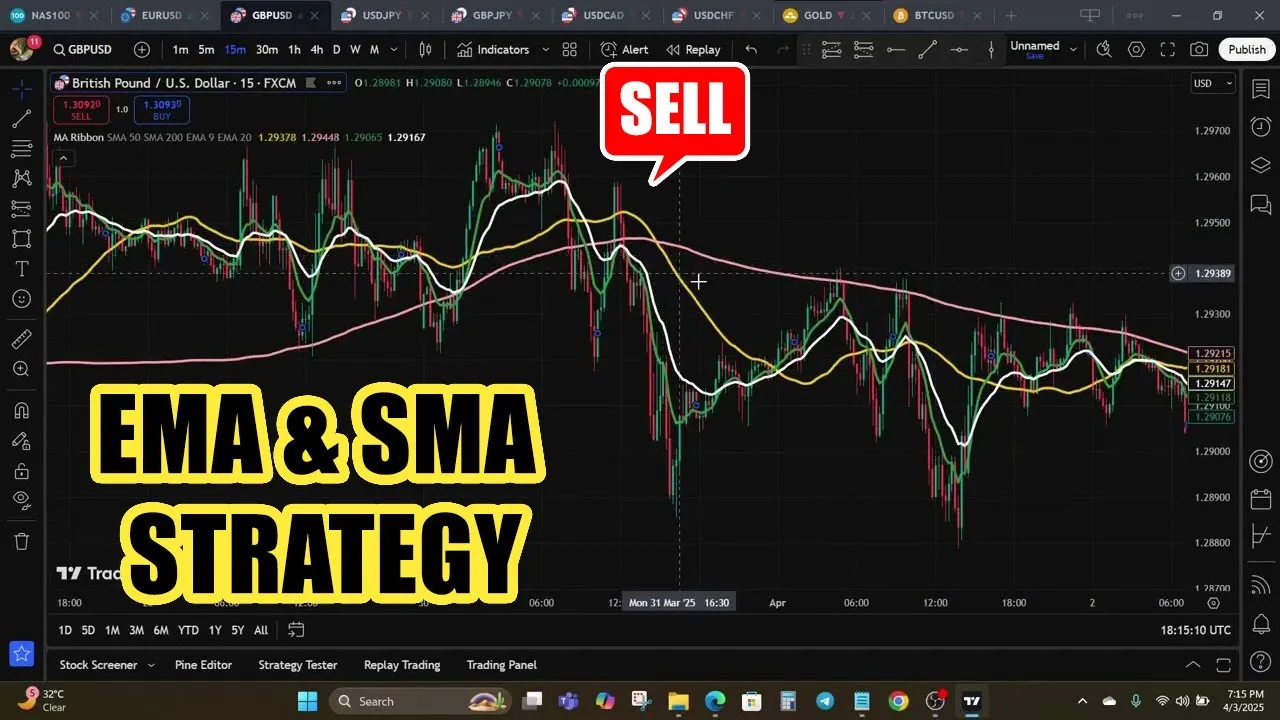
Mastering Moving Averages: A Comprehensive Guide to SMA, EMA, and Trading Signals
Image source: EMA and SMA Strategy Explained – Master Trend Trading With This Simple Moving Average System
Moving averages are trend-following technical indicators that smooth price data to reveal the underlying direction. The Simple Moving Average (SMA) gives equal weight to all prices in a period, while the Exponential Moving Average (EMA) weights recent prices more heavily, making it faster to react to new information. 1, 2
Key Differences: SMA vs. EMA
| Aspect | SMA (Simple) | EMA (Exponential) |
|---|---|---|
| Calculation | Sum of prices ÷ number of periods 2 | Applies weighting multiplier to recent prices 1 |
| Responsiveness | Slower, smoother line 1 | Faster, tracks price more closely 1 |
| Weighting | Equal weight to all data points 2 | More weight to recent prices 6 |
| Best For | Long-term trends, support/resistance 1, 2 | Short-term trading, quick trend signals 1 |
| Whipsaw Risk | Lower (fewer false signals) 2 | Higher (can react to noise) 2 |
How Trading Signals Work
Moving averages generate signals through three main mechanisms:

Common Trading Signals:
- Price vs. MA Position: Price above the moving average suggests an uptrend (bullish); price below suggests a downtrend (bearish) 10
- Golden Cross: Short-term MA (e.g., 50-day) crosses above long-term MA (e.g., 200-day) → buy signal 15
- Death Cross: Short-term MA crosses below long-term MA → sell signal 15
- Pullback Entry: Price retraces to the MA during a trend, then resumes → entry opportunity 15
Common Time Periods
- 9-day & 20-day: Short-term trading, intraday 13
- 50-day: Medium-term trend identification 13, 15
- 200-day: Long-term trend, major support/resistance 6, 15
The 200-day SMA is particularly significant as a conventional benchmark that many traders watch, which can create self-fulfilling support/resistance levels. Choose SMA for stability in long-term charts and EMA for responsiveness in short-term trading. 2, 4
References
-
MA, SMA, EMA, WMA: A Complete Guide for Traders Explained by GC
-
Mastering Moving Average: How to Use and SMA vs EMA - Gotrade
-
The Four Moving Averages Every Beginner Trader Should Understand
-
Moving Averages Explained: A Beginner’s Guide to SMA and EMA …
-
Moving Average Explained | SMA & EMA for Beginners | Trading Basics
-
Moving Average Trading Strategy | SMA- EMA Indicator Explained
-
Exponential Moving Average (EMA) Trading Strategy | Capital.com EU
-
How to Use Moving Averages (MA) | Learn to Trade | OANDA | US
-
EMA and SMA Strategy Explained – Master Trend Trading With This Simple Moving Average System